


Solar Battery Rebates Explained: What's Changing in January 2027?
Same battery. Different installation date. Different rebate. Here’s why.
If you’re considering battery storage for your Queensland home, there’s an important change coming on 1 January 2027. Australia’s federal battery discount isn’t disappearing, but the way it’s calculated is changing.
Here’s what you should know before choosing a system.
1. What’s Changing in January 2027?
Under Australia’s Cheaper Home Batteries Program, eligible batteries receive a discount calculated using Small-scale Technology Certificates (STCs).
One part of that calculation is the STC factor, which decreases over time.
| Installation period | STC factor |
|---|---|
| May–December 2026 | 6.8 |
| January–June 2027 | 5.7 |
| July–December 2027 | 5.2 |
This means the same eligible battery may receive fewer certificates if installed in January 2027 rather than December 2026.
The important distinction: the program continues. Only the incentive calculation changes.
2. Why Battery Size Matters
A larger battery doesn’t automatically mean a proportionally larger discount.
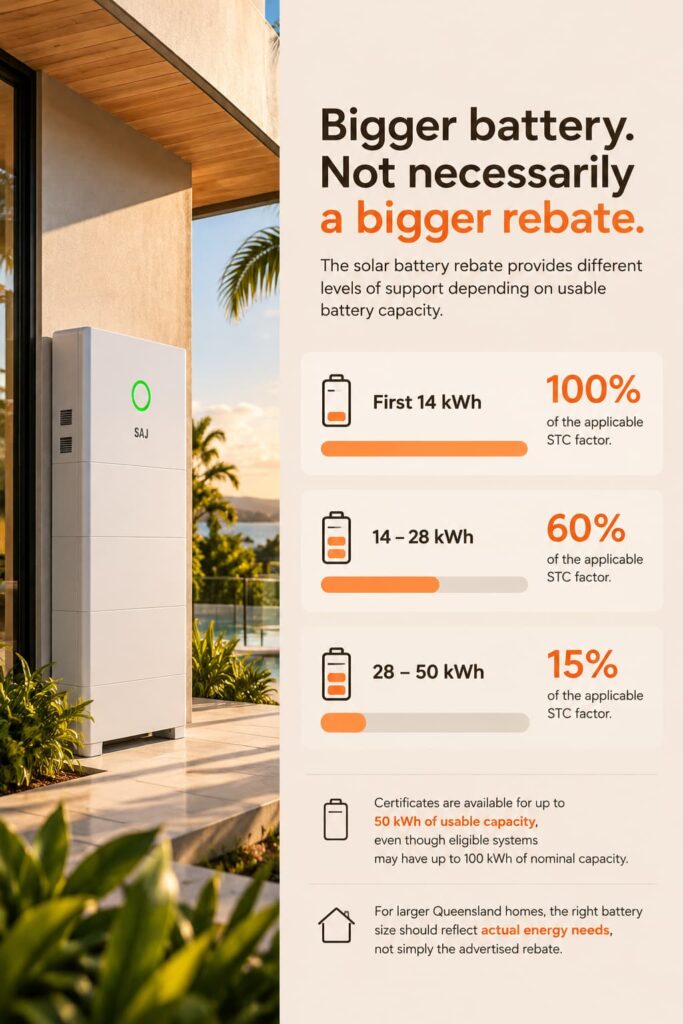
The program applies different levels of support depending on usable battery capacity:
First 14 kWh: 100% of the applicable STC factor.
14–28 kWh: 60% for the additional capacity.
28–50 kWh: 15% for the additional capacity.
Certificates are available for up to 50 kWh of usable capacity, even though eligible systems may have up to 100 kWh of nominal capacity.
For larger Queensland homes, this matters because the right battery size should reflect actual energy needs, not simply the advertised rebate.
3. Does the Installation Date Really Matter?
Yes. The applicable STC factor is determined by the battery’s installation date, rather than simply when you request a quote or place an order.
For program purposes, installation is tied to the relevant electrical compliance certification.
That means a system quoted in December 2026 but installed and certified in January 2027 would generally be assessed using the January 2027 factor, provided it meets the program requirements.
The final dollar discount also depends on the number of eligible certificates and their market value. So, the STC factor alone isn’t a guaranteed rebate amount.
4. What Should Queensland Homeowners Consider?
Before choosing a battery, look beyond the advertised rebate.
For a premium home with extensive air conditioning, a swimming pool, EV charging or substantial evening electricity demand, the right battery size depends on how the property actually uses energy.
It’s worth reviewing your solar generation, usable battery capacity, inverter compatibility, installation requirements and future energy needs. You should also confirm that the proposed equipment and installer meet the program’s eligibility rules.
The best decision isn’t necessarily the battery with the largest rebate. It’s the system that makes sense for your home.
Make an Informed Decision, Not a Rushed One
The January 2027 changes are worth understanding, but they shouldn’t be the only reason to install a battery.
At Weglow, we help Queensland homeowners explore solar and battery solutions designed around their property, energy demands and lifestyle.
Considering battery storage for your home? Talk to Weglow about your options and the incentive rules that may apply to your installation.
Program information reflects the published rules as at October 2026. Eligibility and final discount values depend on the installation and applicable requirements.